

.png?width=27&height=27&name=Group(1).png)

-1.svg)
-1.svg)


-2.svg)


%201-1.webp?width=148&height=74&name=our%20work%20(2)%201-1.webp)




.svg)





.jpg?width=670&height=445&name=What%20is%20Retrieval%20Augmented%20Generation%20(RAG).jpg)
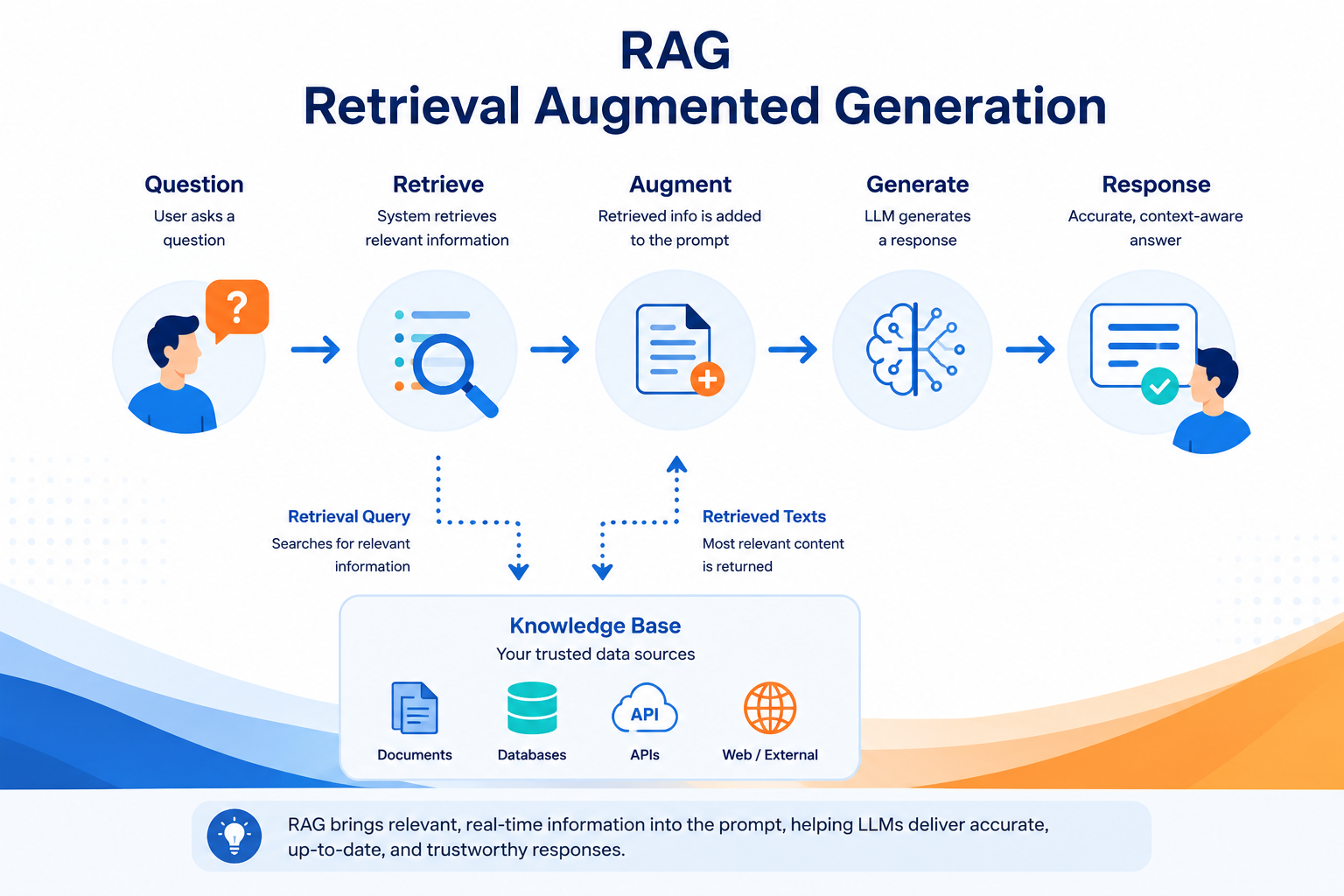
Retrieval-Augmented Generation (RAG) is an AI architecture that combines a large language model (LLM) with an external information retrieval system. Instead of relying only on what the model learned during training, a RAG-powered system searches a trusted knowledge base for relevant, up-to-date information before generating a response.
This approach helps overcome two major limitations of traditional LLMs: outdated knowledge and AI hallucinations. By grounding responses in retrievable, authoritative sources, RAG improves accuracy, provides domain-specific context, and enables users to verify the information used to generate answers.
Who Introduced the Term Retrieval-Augmented Generation?
The term Retrieval-Augmented Generation (RAG) was introduced in a 2020 research paper titled "Retrieval-Augmented Generation for Knowledge-Intensive NLP Tasks," co-authored by Patrick Lewis and his team.
Patrick Lewis, now Director of Machine Learning at Cohere, has continued to advance RAG's applications, focusing on improving AI's ability to reference external sources and provide verifiable information.
Must read: Understanding RAG: Architecture, Techniques, Use Cases, & Development, to get a comprehensive understanding of RAG's foundational concepts.
What is RAG in Layman’s Terms?
Think of a standard Large Language Model as a student taking a closed-book exam. It relies entirely on what it memorized during study hours (its pre-training phase). If a question is about something that happened after its study period, it must guess, often leading to confident but completely false answers (known as hallucinations).
RAG turns this into an open-book exam.
When you ask a RAG-enabled AI a question, it doesn't just guess. It instantly runs to a library (your databases, files, or APIs), pulls out the most relevant book pages, reads them, and then writes a precise, factual answer based directly on those pages.
How Does Retrieval-Augmented Generation Work?
A production-grade RAG pipeline consists of two distinct phases: Data Preparation (Ingestion) and Runtime Execution (Query & Generation).
Phase 1: Data Preparation & Ingestion
Before the AI can retrieve information, your documents must be made searchable for a machine.
1. Document Ingestion & Chunking: Data Parsing
Raw files (PDFs, APIs, databases, Slack messages) are collected. Because documents can be massive, they are split into smaller, logical "chunks" (e.g., 500-character segments) to preserve granularity.
2. Generating Vector Embeddings: Mathematical Translation.
Each chunk is processed through an embedding model (like OpenAI text-embedding-3 or Cohere Embed). This model converts semantic text into high-dimensional numerical vectors (coordinates) representing the conceptual meaning of the words.
3. Storage in a Vector Database:Indexing.
These numerical vectors are saved inside a specialized vector database (such as Pinecone, Milvus, or Qdrant). This allows the system to perform blazing-fast semantic mathematical lookups later.
Phase 2: Runtime Retrieval and Generation
When an end-user submits a prompt, the system executes the following operational steps:
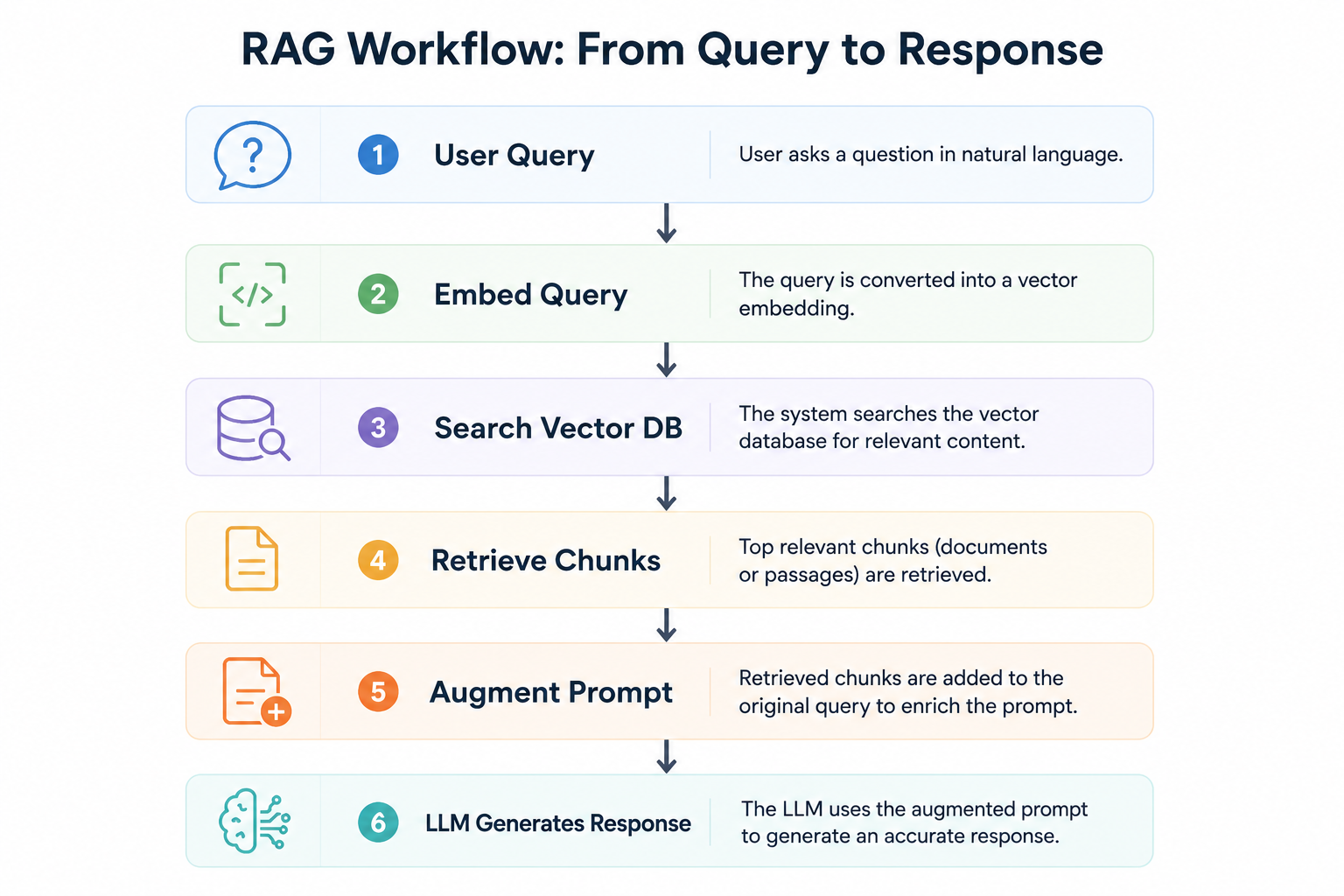
- Query Embedding: The user’s input is converted into a vector coordinate using the exact same embedding model used in the ingestion phase.
- Similarity Search: The system runs a mathematical similarity calculation (like cosine similarity) to find the text chunks in the vector database closest in meaning to the user's query.
- Contextual Augmentation: The system retrieves the raw text of those top-ranking chunks and merges them directly into the LLM's prompt window alongside the original user query.
- Grounded Generation: The LLM reads the integrated context and drafts an answer strictly constrained by the provided source documents.
Must Read: Our Comprehensive Guide Explaining the RAG Pipeline
What are the Benefits of Retrieval-Augmented Generation?
Retrieval-Augmented Generation (RAG) helps organizations build more accurate, reliable, and scalable AI applications by combining the reasoning capabilities of large language models with trusted external knowledge. Instead of relying solely on static training data, RAG enables AI systems to deliver responses that are grounded in current, domain-specific information. Some of its key benefits include:
- Cost-Effective: Organizations can leverage existing foundation models without the expense of retraining them for every new use case, making generative AI more affordable to deploy.
- Access to Current Information: AI systems retrieve the latest information from connected knowledge bases, ensuring responses remain accurate, relevant, and up to date.
- Enhanced User Trust: By providing source attribution, RAG increases transparency and enables users to verify information against the original documents, improving confidence in AI-generated responses.
- Greater Developer Control: Developers gain greater control over AI behavior by choosing and managing the external knowledge sources used during retrieval, allowing models to be tailored to specific business domains without extensive retraining.
- Improved Response Quality: Retrieved context enables LLMs to generate more comprehensive, accurate, and contextually relevant responses, resulting in a better user experience.
- Reduced Hallucinations: Grounding responses in trusted external data significantly reduces AI hallucinations and improves the factual reliability of generated content.
- Supports Enterprise-Grade AI Applications: Because RAG works with live, domain-specific knowledge, it is well suited for enterprise use cases such as customer support, healthcare, legal research, financial services, and internal knowledge management, where accuracy and traceability are essential.
To gain a better understanding of RAG's practical applications in various industries, check out 10 Real-World Examples of Retrieval Augmented Generation.
Retrieval-Augmented Generation (RAG) vs. Semantic Search
Understanding the Differences
While both RAG and semantic search involve retrieving relevant information, they serve distinct purposes and operate on different principles.
- Semantic Search is about finding. It takes a conceptual query (e.g., "How do I reset my account?") and finds the most relevant documents, even if they don't contain the exact keywords. It outputs a list of search results.
- RAG is about finding AND explaining. It uses semantic search as its first step (the retrieval), but then hands those findings over to an LLM to synthesize, summarize, and write a human-like, direct answer to the user.
The Synergy: You cannot have high-performing RAG without robust Semantic Search. Semantic search feeds the high-quality raw ingredients that the generative model cooks into a cohesive final response.
RAG Infrastructure Options
If you are building inside enterprise ecosystems, you will typically leverage cloud provider integrations to deploy, scale, and manage your vector assets.
Google Cloud & Vertex AI Ecosystem
- Vertex AI Search: A fully managed, out-of-the-box RAG platform that handles document ingestion, semantic chunking, and generation in one integrated API.
- Vertex AI Vector Search: A highly scalable, low-latency index engine designed to handle billions of vector embeddings for custom enterprise RAG pipelines.
- BigQuery Vector Search: Allows you to generate embeddings and run similarity searches directly inside your existing SQL data warehouse without moving files.
Must Read: RAG vs. Traditional Search: A Comparative Analysis
Key Challenges of Production RAG (and How to Solve Them)
While building a basic RAG prototype takes minutes, taking it to production reveals complex challenges:
- Data Quality and Formatting: If your internal files are messy, duplicative, or poorly formatted, your retrieval will return "garbage in, garbage out."
Solution: Implement robust preprocessing pipelines to sanitize tables, PDFs, and charts. - Lost in the Middle: LLMs struggle to read long context windows and often ignore documents buried in the middle of a retrieval list.
Solution: Implement a Reranker (such as Cohere Rerank) to prioritize only the top 3-5 hyper-relevant chunks before prompting the LLM. - Complex Data Relationships: Standard RAG treats text as isolated chunks, missing the broader connections. Solution: Adopt GraphRAG, which maps information as nodes and entities to understand complex, multi-hop logical relationships.
RAG vs. Fine-Tuning: Which Approach Should You Choose?
When organizations need an LLM to work with specific corporate knowledge, they face a critical architectural choice: Do we implement RAG, or do we fine-tune the model?
While RAG provides a model with an "open-book" reference context at the exact moment a question is asked, Fine-Tuning updates the model's underlying brain weights through training. This teaches the AI new styles, formatting rules, or highly specialized terminology, effectively making it a "closed-book" expert.
| Feature | RAG (Retrieval-Augmented Generation) | Fine-Tuning |
| Primary Goal | Accessing specific, verifiable factual data. | Optimizing tone, style, formatting, and behavioral alignment. |
| Knowledge Updates | Dynamic and real-time. Simply update the vector database. | Static. Requires running a new training job to learn new data. |
| Hallucination Risk | Minimal. Responses are constrained by source citations. | Higher. The model relies on internal statistical memorization. |
| Setup & Compute Cost | Low to Moderate (Vector database storage and operational query fees). | High (Requires GPU computing hours for training runs). |
| Data Privacy (ACL) | Easy. Filter search results based on user access tokens. | Hard. If a user trains a model on data, anyone can potentially query it. |
Related Read: RAG vs. Fine-Tuning - A Detailed Comparison
The Rule of Thumb for Architects
- Choose RAG if: Your data changes constantly (e.g., live documentation, customer support tickets, inventory levels) and absolute factual accuracy with source verification is critical.
- Choose Fine-Tuning if: Your underlying data is stable, but you need the model to strictly follow complex internal logic, output specialized syntax (like custom code layouts), or adapt to a highly specific corporate voice.
Pro Tip: RAG and Fine-Tuning are not mutually exclusive. High-performance enterprise AI applications often combine both. For example, you might fine-tune a smaller model to perfectly understand complex legal terminology, and then wrap that fine-tuned model in a RAG pipeline so it can search real-time court case registries safely.

Mangesh Gothankar


Ashwani Sharma
Achin Verma
Conclusion
Retrieval-Augmented Generation has revolutionized how modern enterprises interact with their data. By converting your static knowledge assets into dynamic, vector-searchable indexes, RAG transforms LLMs from simple chatbots into intelligent, context-aware business engines.